Most players know which three-point spot they like. Fewer know which one is actually their best, or their worst. The five-spot test answers that with numbers: 10 shots from each of the five three-point zones, logged one by one.
It is not a full practice session. It is a measurement you take once in a while, so you can decide where your practice time goes.
The test in 4 steps
- Warm up. Start with close shots, then a few threes, so the first spot is not your warm-up.
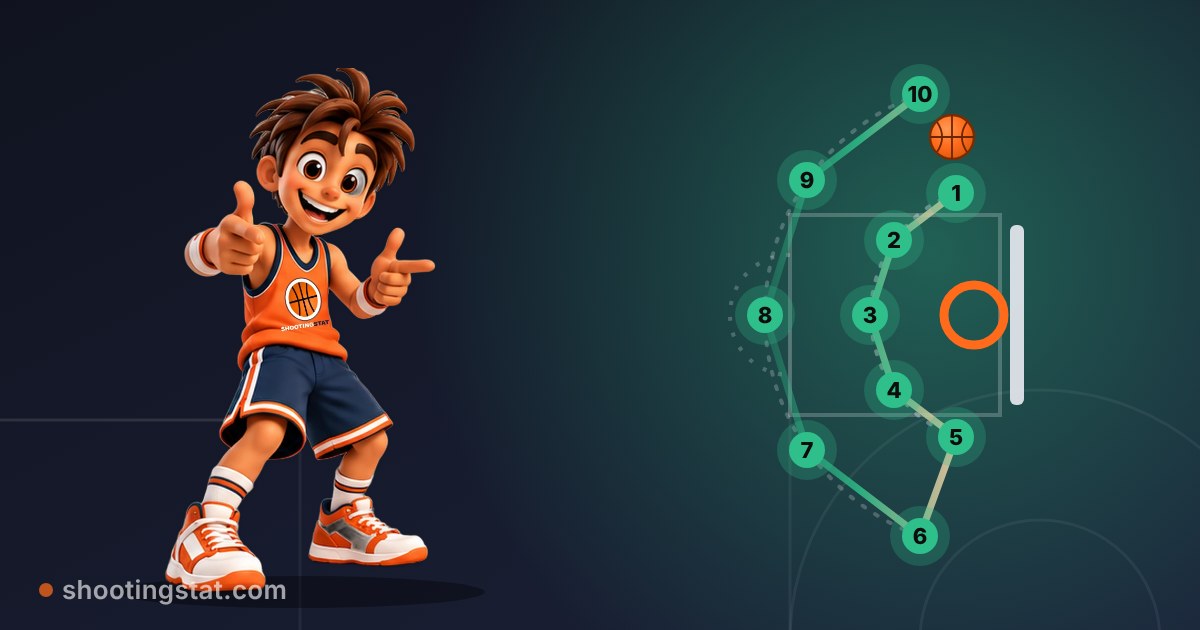
- Shoot 10 from each zone. Go around the arc, using the five three-point zones on the court map (zones 11 to 15). Use your normal routine on every shot, and rest the same amount between zones.
- Log every shot in its zone. Log makes and misses with the same care, right after each shot.
- Rotate the starting spot next time. The last zones are shot when you are more tired, so change the order from test to test.
How to read the results
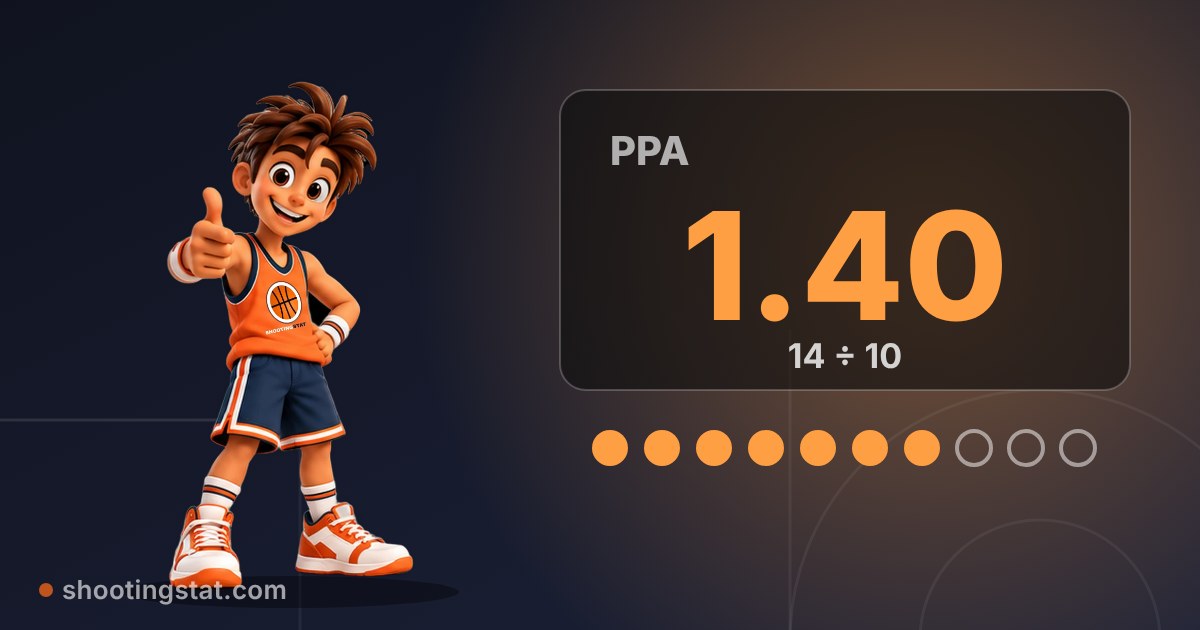
Open the zones tab. For each zone, look at three things: the makes and attempts, the percentage, and the points per attempt (PPA). In a three-point zone, PPA is your percentage times 3, and we explained it in points per attempt.
Here is an example with made-up numbers, not a real player:
| Zone | Makes | Attempts | Percentage | PPA |
|---|---|---|---|---|
| Spot 1 | 4 | 10 | 40% | 1.20 |
| Spot 2 | 3 | 10 | 30% | 0.90 |
| Spot 3 | 5 | 10 | 50% | 1.50 |
| Spot 4 | 2 | 10 | 20% | 0.60 |
| Spot 5 | 4 | 10 | 40% | 1.20 |
That is 18 makes in 50 shots, or 36%, which gives a PPA of 1.08. A good reference is the break-even point: 33.3% from three gives a PPA of 1.00, the same as 50% from two. In this example, spots 2 and 4 are below that line, and spot 4 looks like the weakest.
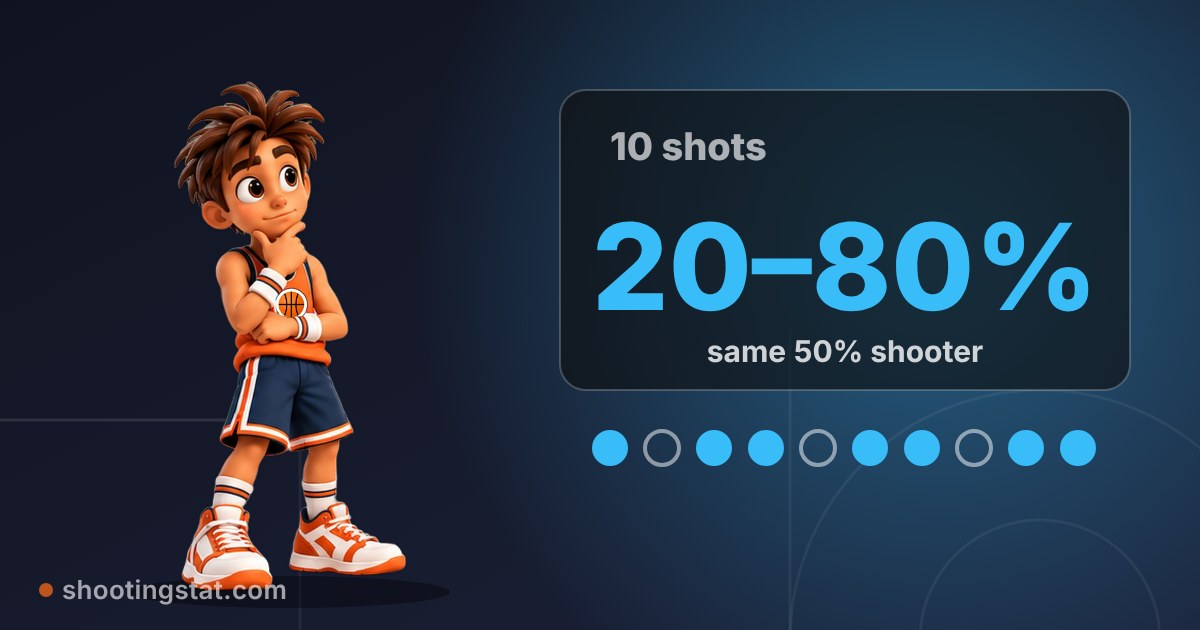
But look at the attempts: only 10 in each zone. In our article on small samples, a true 50% shooter's result over 10 shots can land anywhere from about 20% to 80%. So the gap between 2 of 10 and 5 of 10 is well inside what luck alone can produce. Spot 4 is a suspect, not a verdict.
What to do with the results
- Repeat the test on three different days. You then have 30 attempts per zone, and a true 50% shooter's results over 30 attempts land between about 33% and 67%, which is far tighter than over 10.
- Add up the three tests per zone. Compare the totals, not each test.
- If a zone stays the weakest, give it focus. Add two sessions of 20 shots from that zone, with the same routine, and note whether your misses are short, long or to the side. Our common shooting mistakes article explains how to read them.
- Retest after two weeks with the same test, and compare the totals.
One analysis of college data (around 2013) found that threes taken from near the baseline went in more often than threes from the wing angles. That may or may not be true for you, so check it against your own numbers.
Common mistake
- Don't change your form because of one test. Chance alone can make a zone look bad.
- Don't shoot the test when exhausted. In one meta-analysis, three-pointers were the shots hit hardest by severe fatigue, so keep the test for a fresh start of a session, or compare it with a tired version in a separate session.
- Don't compare tests with different numbers of shots. Keep it at 10 per zone.
For coaches
Run the test with players in pairs: one shoots, one rebounds and logs. It suits a team that shoots from the same five zones. Add the totals per zone for the whole team, and note whether the group is weaker from one side of the court. This also feeds the shooting session you plan for your team.
Summary
- Take 10 shots from each of the five three-point zones and log each one.
- Read the percentage and the PPA for each zone, and compare them with the 33.3% break-even point.
- A weak zone from one test is a suspect, not a verdict.
- Repeat the test on three days, then focus on the zone that stays weakest.
This week, run the five-spot test once and keep the numbers for comparison.