The free throw is the one shot you take from the same spot, at the same distance, with no defender. That makes it one of the most trainable shots in the game. Even so, percentages drop in games, especially in the big moments.
So it isn't enough to repeat the shot a hundred times without thinking. In this article we suggest a short session in 4 parts, starting with your routine and ending with game-like pressure. The numbers and the order are our suggestion, built on drills from well-known coaches.
Worked example
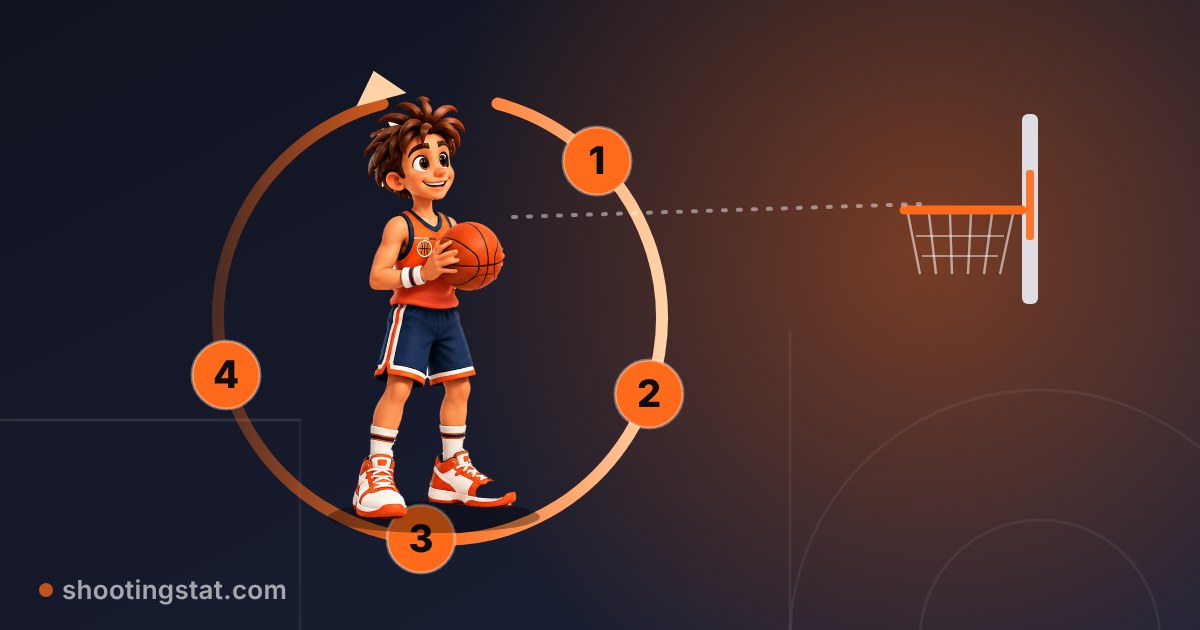
The session in 4 parts:
- Routine: 10 shots, in 5 sets of two.
- Test: 10 shots, with a target of 8 makes.
- Streak: as many shots in a row as you can in 5 minutes.
- Pressure: 10 shots with an imaginary score.
The four parts in order, and what you log in each.
01Why practice from the line itself?
A University of Bern study found that amateur players were more accurate from the free-throw line than their accuracy from nearby distances would predict. The researchers explained it as an especial skill, a skill that comes from heavy repetition at one exact spot. The study is small, with 16 players, so we don't overstate it. But the practical lesson is simple: practice free throws from the line itself, not from somewhere near it.
02Part one: the routine in sets of two (10 shots)
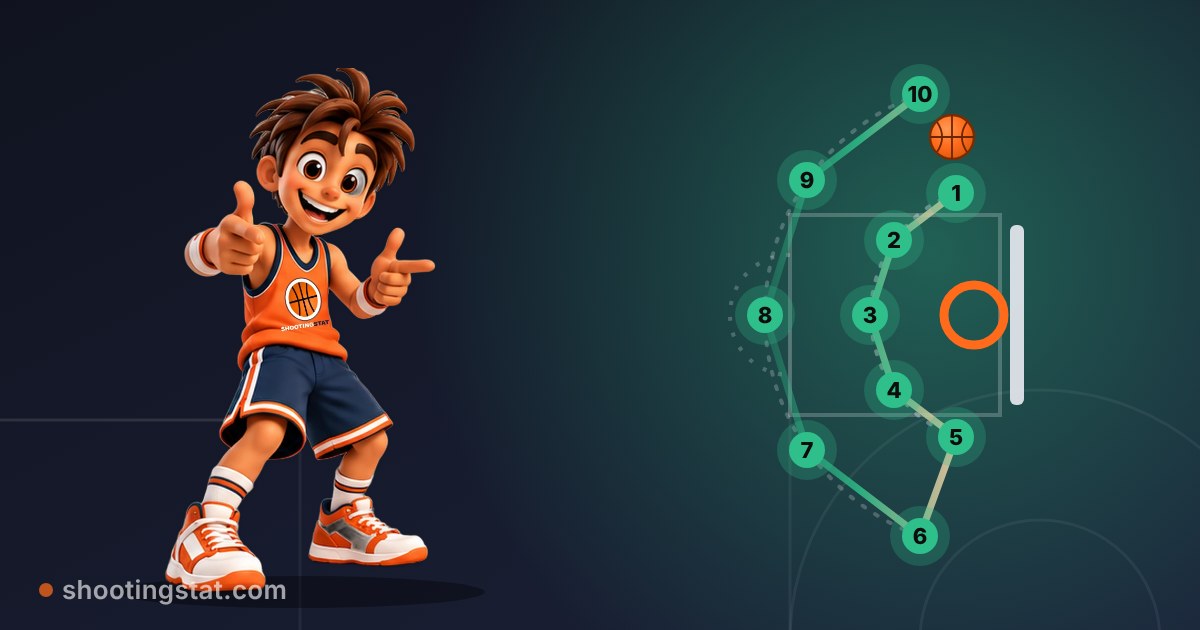
In a game, a player rarely takes more than two free throws in a row. That is why coach Hal Wissel advises never taking more than two shots without stepping off the line. So shoot 5 sets of two here, and step off the line between sets before coming back.
Use your full routine on every shot, as we explained in the free-throw routine. Wissel's advice is to adopt a sound routine and stay with it, and he calls copying fads or changing your routine repeatedly a mistake.
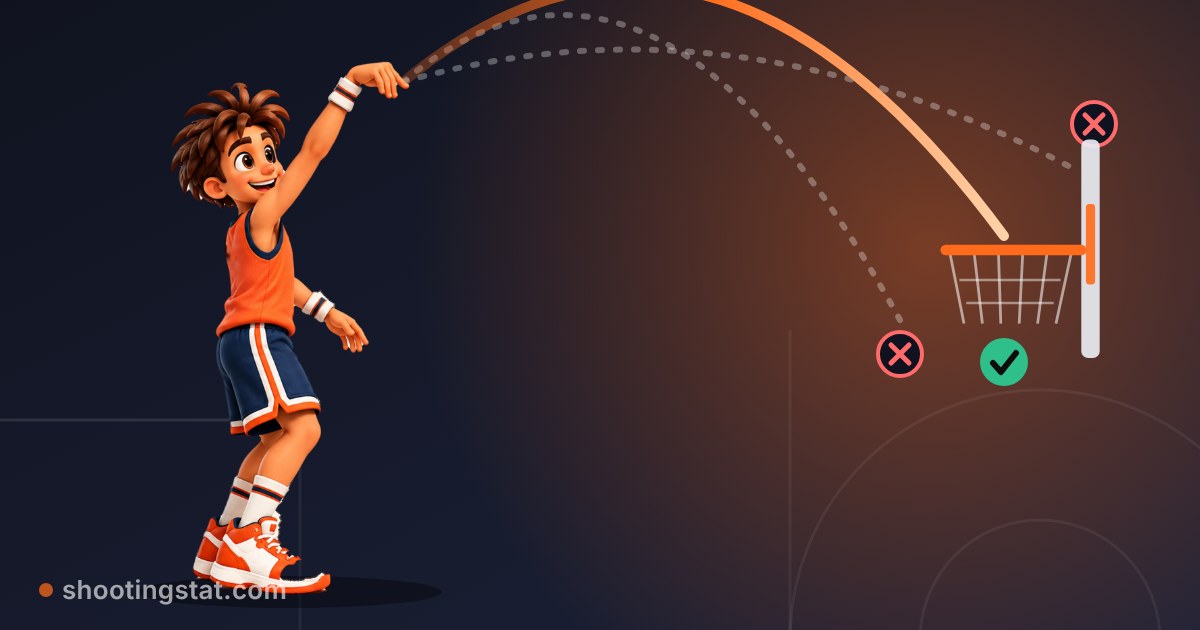
On every shot, keep your attention on the rim, not on your wrist. One study of 14 participants found that focusing on the basket was more accurate, and used less arm muscle activity, than focusing on the wrist. It is a small study from 2005, so take it as guidance, not a rule.
03Part two: the test (10 shots, target 8)
This part is based on the Shoot 10 drill on Coach's Clipboard: 10 free throws, with a target of 8 makes. The site punishes players who miss the target with running or push-ups; we simply record the result, which is our suggestion.
Don't be discouraged if you don't hit 8 every time. The same site notes, in a similar team drill, that game performance usually falls below practice percentages, and it lowers that drill's target for younger players to 70 or 75 percent. If you are a beginner, make your target 7, and raise it once you are consistent.
04Part three: the streak (5 minutes)
This part is based on the 6 In-A-Row drill on the same site: you have to make a set number of shots in a row within 5 minutes, and any miss resets the count to zero. The site asks for 6 in a row, and raises it to 8 for varsity boys. Pick a number that suits you, such as 5, and shoot until you reach it or the time runs out.
Write down your longest streak, which is something Wissel suggests too. This gives every shot weight, because a miss wipes out what came before.
05Part four: game-like pressure (10 shots)
Researcher Toma analyzed more than 2 million free throws in the NBA, the WNBA and college basketball between 2002 and 2013. He found that accuracy falls in the final 30 seconds of close games. The drop was about 5.81 percentage points in the WNBA, 3.11 in the NBA, and 2.09 in men's college basketball. In women's college basketball it was 2.25, and the difference was not statistically significant. The study is observational, so it can't prove the cause, but it suggests that pressure is real at every level.
That is why we finish the session with the Finish the Game drill from Coaching Toolbox. The idea is to put an imaginary, late-game score on the board, so every shot has a cost. This is our solo version:
Start with an imaginary score: your team 45, the opponent 44.
Every make adds a point for your team, and every miss adds two points for the opponent.
Shoot 10 shots. You win if you make at least 7 of them.
If you lose, repeat the part once, and no more.
In the original, the drill is run at the end of practice to add fatigue to the pressure. It is close to game conditions, and a 2025 meta-analysis found that moderate mental fatigue lowers free-throw accuracy. So don't expect the same percentage as in the test. To make it easier, start with a bigger lead, as the site suggests for younger teams.
06How do you log it?
Log parts two and four in ShootingStat, because each has a fixed number of attempts: 10 shots. Don't log the routine, since it is a warm-up, or the streak, since its number of attempts varies. Write your longest streak in the session title.
Remember that in 10 attempts a single shot moves your percentage by 10 points, so compare several sessions, not two. Free throws don't count in FG%, but they do count in TS%, as we explained in the difference between the three percentages.
Practice from the free-throw line itself, with one fixed routine.
Don't take more than two shots without stepping off the line, as in a game.
Test yourself with 10 shots and a target of 8, and log your longest streak.
End the session with game-like pressure, and don't expect your usual percentage.
This week, pick two of the four parts, log them, and then add the rest.
FAQ
How many free throws should I shoot each day?
There is no single right number. Coach Hal Wissel suggests a set number each day, often in sets of 10 after other drills. Nike recommends at least 10 to 15 minutes of each session. Pick a number you can stick to.
Why does my percentage drop in games?
Pressure is a known cause. A study of more than 2 million free throws in the NBA, WNBA and college basketball found that accuracy fell in the final 30 seconds of close games, by roughly 2 to 6 percentage points depending on the league. That is why we practice pressure on purpose at the end of the session.
Should I practice while tired?
In the last part, yes, because games come with fatigue. A 2025 meta-analysis found that moderate mental fatigue lowers free-throw accuracy. Don't be discouraged if your percentage dips a little here, but keep your routine.
Does it matter that I shoot from the line itself?
Yes, and a small study of 16 players supports it: their accuracy from the free-throw line was higher than their accuracy from nearby distances would predict, an effect of repetition from that exact spot.