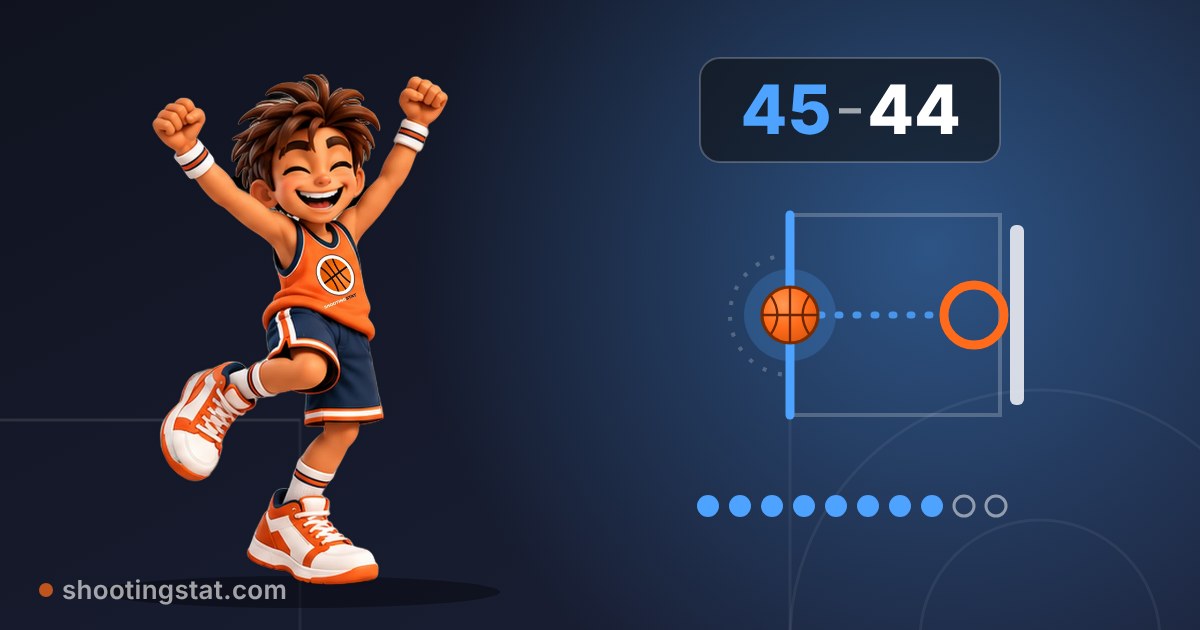
You stand at the free-throw line, nobody can contest the ball, and it looks like the simplest shot in the game. Yet many players miss it more often than they expect. One possible reason is that every shot is different from the one before: sometimes you bounce the ball twice and take your time, and sometimes you rush and shoot right away.
In this article we explain what a routine is, what research has found about it, and how to build your own in 4 steps and practice it.
Worked example
The routine in 4 steps:
- Stance: steady feet and relaxed shoulders.
- Ball: a fixed number of moves, then the ball settles on your fingertips.
- Eyes: one spot to lock onto.
- Shot and finish: one smooth push and the same finish every time.
The 4-step routine, repeated before every shot.
01What is a pre-shot routine?
Researchers define a pre-performance routine as a set of task-relevant thoughts and actions that an athlete performs systematically before carrying out a skill. For a free throw it could look like this: you set your feet, bounce the ball twice, look at the rim, then shoot.
02What does the research say?
In 2008, researchers Chris Lonsdale and Jimmy Tam studied 284 free throws in 14 NBA play-off games. They found that each player had a sequence of behaviors he repeated most of the time. The players' success rate was 83.77% when they followed their usual sequence, and it dropped to 71.43% when they deviated from it. The length of the routine, whether brief or long, made no significant difference to the success rate.
So consistency matters more than speed or slowness.
A meta-analysis published in 2024 pooled the results of many studies on pre-performance routines in sport. It concluded that routines help, with a moderate-to-large effect in experimental studies, both in ordinary conditions and under pressure. The effect did not differ by routine type.
Not every study agrees. A small 2001 study of 17 college men found that changing the movements of the routine hurt performance, while lengthening its time did not. On the other hand, a university manuscript on NCAA Division I players found that routine consistency did not predict game free-throw percentage.
Key point
These findings don't mean a particular routine is the best one. The Lonsdale and Tam study observed players rather than testing them, so it can't prove the routine caused the difference. And the meta-analysis covers many sports, not basketball alone. The practical takeaway: a simple routine, repeated consistently.
03How do you build your routine in 4 steps?
There is no single routine that fits everyone. As Nike's guide puts it, each player has their own rhythm. But these 4 steps bring together what Nike and Jr. NBA recommend, so use them as a starting point and then adjust them to suit you.
Step one: stance and relaxation
Stand behind the line with your feet flat on the floor and your knees slightly bent. There is no single required foot position: some players line both feet up square to the hoop, and others step forward with the shooting foot. Then relax your shoulders and hands, because tension keeps the ball from rolling off your fingers as it should.
Step two: the ball
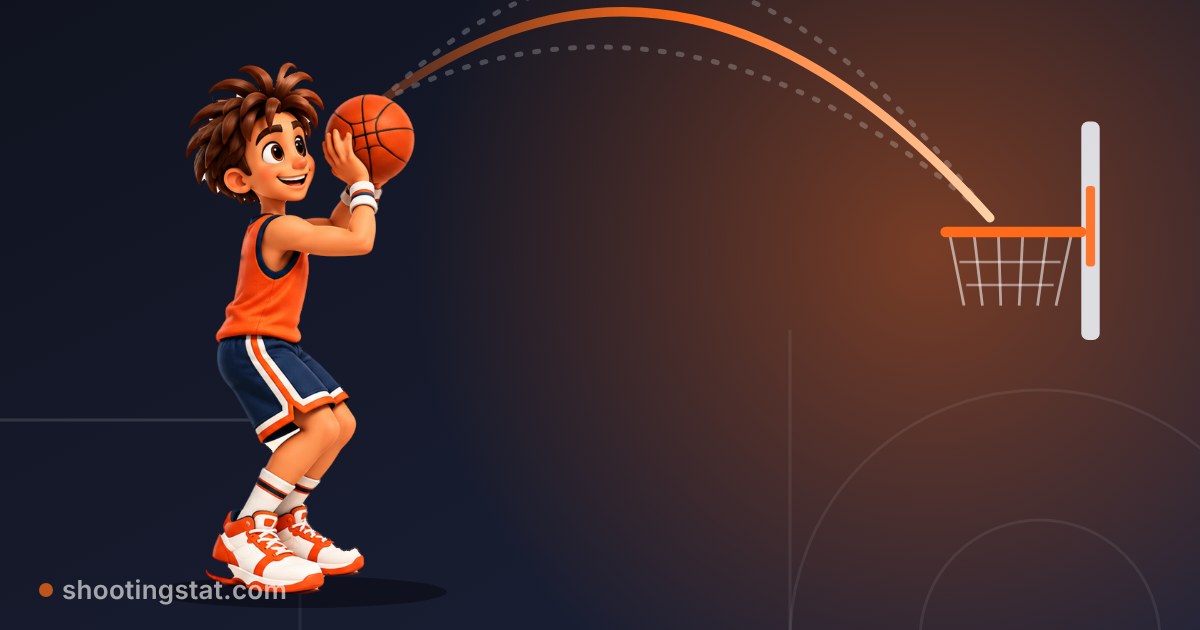
Choose a simple move you repeat, such as bouncing the ball a fixed number of times or spinning it in your hands. Then set it in your shooting hand on your fingertips. Nike says the laces run across your fingers, with the other hand supporting from the side. We covered this in the basic steps of a sound shot.
What matters is that the number is the same every time. If you choose two bounces, make it two bounces every time.
Step three: your eyes
Lock your eyes on one spot. Jr. NBA suggests the back of the rim, or a spot just over the front of it. A specific spot gives your eyes something steady to hold. If you like, add a short cue word that you say to yourself, as one of the coaches in Nike's guide suggests, one that reminds you of a place where you have practiced a lot.
Step four: the shot and the finish
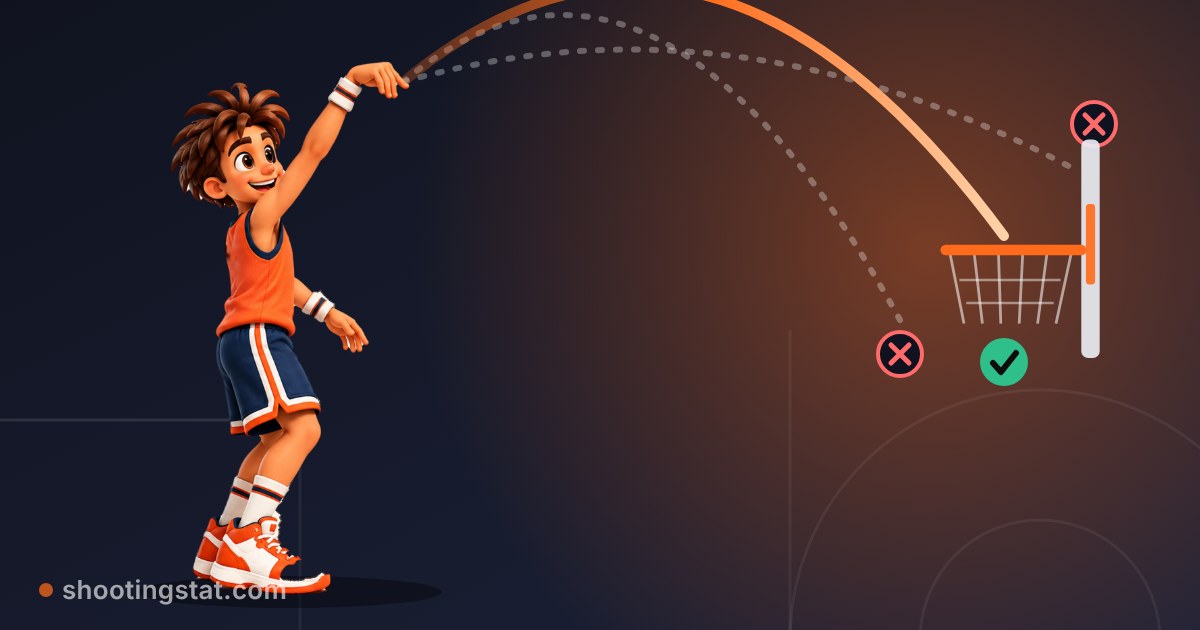
Push the ball with your legs, body and arm in one motion, then finish the same way on every shot. You don't need to jump. Jr. NBA explains that jumping often creates forward momentum, so you may step on or over the line, and that NBA players don't jump but get full extension in their legs and lower body as they shoot. This can be harder for younger players, so their size and strength should be taken into account.
04Rules that make a routine work
Same order, same count. Repeat the same routine on every shot, whether or not the previous one went in.
Short and simple. 4 steps are enough, so don't turn it into a burden.
Practice it from the first shot. Don't save it for games only. This is our suggestion, so the routine becomes a habit.
After a miss, go back to step one. Don't change the routine, and don't rush.
05How do you practice it?
Nike recommends spending at least 10 to 15 minutes of each session on free throws. One of its coaches suggests adding pressure in practice: you need to make 3 shots in a row, with a sprint down the court and back for every miss.
Worked example
A sample short session:
- 20 free throws, each with the full routine.
- Then a challenge: 3 makes in a row, and a sprint down the court and back for every miss.
06How do you know it helps?
Log every free throw in ShootingStat. The app shows your free-throw percentage separately from your two-point and three-point percentages. Remember that free throws are not part of FG%, but they are part of TS%, which we explain in the difference between the three percentages.
And watch the number of attempts. In 10 attempts, a single shot moves your percentage by 10 percentage points, and in 20 attempts by 5 points. So pick a fixed number of attempts per session, compare several sessions, and don't change your routine every day.
07Summary
A routine is a set of fixed thoughts and actions you perform before every free throw.
Consistency matters more than speed, and more than the shape of the routine itself.
Build yours in 4 steps: stance, ball, eyes, then the shot and finish.
Practice it on every shot, and log your shots to track progress over several sessions.
Repeat the same steps every time, and compare your sessions with each other.
FAQ
How long should a routine take?
There is no ideal length. In a study of free throws in NBA games, each player's success rate did not differ between short, long and regular routines. What matters is repeating the same steps in the same order.
Should I copy a pro player's routine?
There is no need to. A 2024 meta-analysis found that the benefit of a routine does not depend on its type. Pick simple steps that suit you, and keep them fixed.
Should I jump when I shoot from the free-throw line?
You don't have to. Jr. NBA explains that jumping often creates forward momentum, so a player may step on or over the line. NBA players don't jump, but they extend their legs and lower body fully as they shoot. This can be harder for younger players, so take their size and strength into account.
How many free throws should I log per session?
Pick a fixed number you can finish every session, such as 20. A comparison between two sessions is more honest when the number of attempts is the same.