After every practice you get more than one shooting number. The player asks, "What's my percentage?" The coach asks, "Was today better than last time?" The answer depends on which percentage you look at.
We will calculate all three using the same session, so you can see why the number changes from one percentage to the next.
Worked example
The practice session we will use:
- 20 two-point attempts, 8 made.
- 10 three-point attempts, 4 made.
- 8 free throws, 7 made.
What each percentage counts from the same session.
01FG%: field-goal percentage
This is the most common one. It answers a single question: how many of your field-goal attempts went in? It counts twos and threes together and ignores free throws.
Formula
FG% = FGM ÷ FGA × 100
FGM is field goals made. FGA is field goals attempted.
In our session: FGM = 8 + 4 = 12 and FGA = 20 + 10 = 30, so 12 ÷ 30 = 40%.
Common mistake
FG% treats a three and a two as equal. A player who takes a lot of threes can look worse on paper while scoring more points per attempt.
02eFG%: effective field-goal percentage
This fixes that problem. A three is worth one and a half times a two, so a made three counts as one and a half made shots.
Formula
eFG% = (FGM + 0.5 × 3PM) ÷ FGA × 100
3PM is three-pointers made.
In our session: (12 + 0.5 × 4) ÷ 30 = 14 ÷ 30 ≈ 46.7%. The number rose from 40% to 46.7% because 4 of the 12 makes were threes.
Worked example
Two players each take 20 shots.
Player A makes 10 twos: <bdi>FG% = 50%</bdi>, <bdi>eFG% = 50%</bdi>, 20 points.
Player B makes 8 shots, 5 of them threes and 3 of them twos: <bdi>FG% = 40%</bdi>, <bdi>eFG% = 52.5%</bdi>, 21 points.
Player B has the lower <bdi>FG%</bdi> but scores more from the same number of shots.
Key point
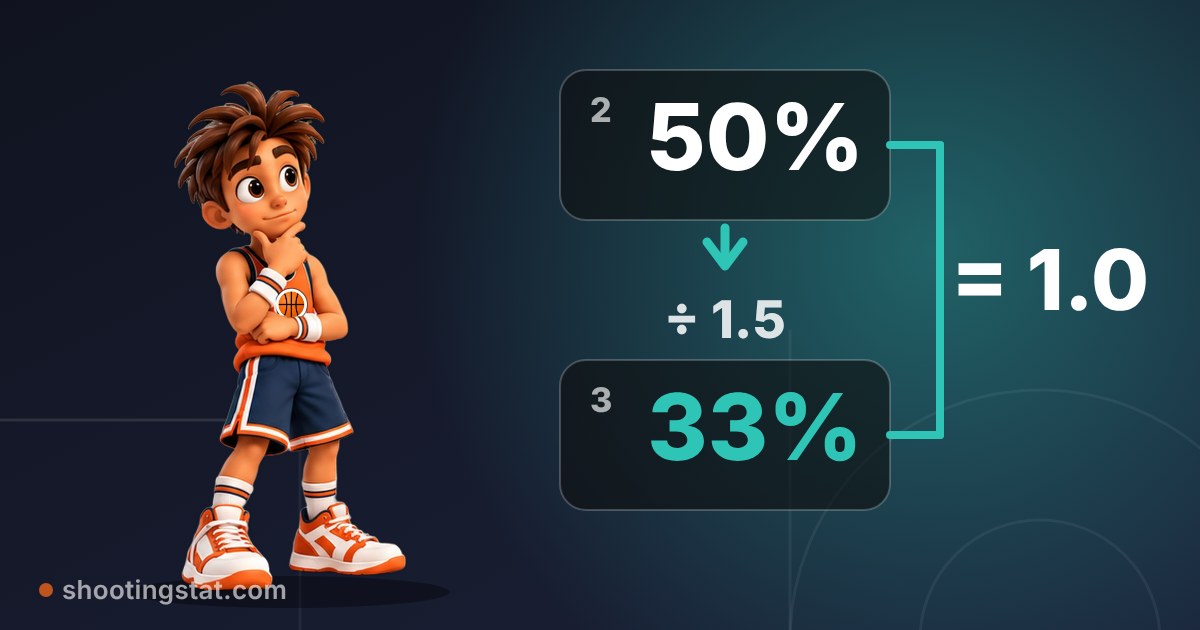
A player who makes a third of their threes (33.3%) matches a player who makes half of their twos (50%). Both score one point per attempt.
03TS%: true shooting percentage
This is the broadest of the three. It adds free throws, so it measures every point a player scored against every attempt used to get them.
Formula
TS% = PTS ÷ (2 × (FGA + 0.44 × FTA)) × 100
PTS is total points and FTA is free throws attempted.
In our session:
Points: 8 × 2 + 4 × 3 + 7 = 35
Denominator: 2 × (30 + 0.44 × 8) = 67.04
Result: 35 ÷ 67.04 ≈ 52.2%
The 0.44 is a statistical estimate, and both Basketball Reference and NBA.com use it. You do not need to memorize it. Just know that free throws are part of scoring efficiency.
Common mistake
Do not compare TS% directly with FG%. They have different denominators and answer different questions. Compare TS% with TS% from other sessions, and FG% with FG%.
04Quick comparison
Metric
Question it answers
Free throws
Our session
FG%
How many field-goal attempts went in?
Not included
40%
eFG%
How efficient is the shooting once threes are valued correctly?
Not included
46.7%
TS%
How efficient is the scoring overall?
Included (estimated with 0.44)
52.2%
No percentage is best in every case. A good number depends on shot distance, pressure, and how many attempts you have.
05Which one should you use?
Want to know whether your accuracy from one spot improved? Use FG%.
Comparing a three-heavy shooter with a two-heavy shooter? Use eFG%.
Judging scoring in a full session or game? Use TS%.
Key point
With young players, compare each player with their own past results, not with other kids. Sound technique and steady progress matter more than any single session's percentage. And a small number of attempts never gives a stable picture.
06How to track your percentages in ShootingStat
Log every attempt during practice, made or missed.
After the session, review the percentages the app shows you.
Compare your numbers with your own previous session, not with other players.
ShootingStat shows your FG%, eFG% and TS% on your stats page, along with 2PT%, 3PT%, and FT% on their own. The zones tab adds points per attempt (PPA) for each court zone, which applies the same idea as eFG% to one spot on the court. You can still work eFG% out by hand from the formula above to check the app.
07Takeaway
FG%: field goals only, the baseline for reading practice.
eFG%: values threes correctly, so it suits comparing shooting styles.
TS%: adds free throws, so it suits judging a full session or game.
Log every attempt honestly, then pick the percentage that answers the question you are asking.
FAQ
Do free throws count in FG%?
No. FG% counts field-goal attempts only: twos and threes. Free throws have their own percentage, FT%, and they are included in TS%.
When should I use eFG% instead of FG%?
When you compare players or sessions with different numbers of threes. eFG% counts a made three at its real value, so a shooter who takes many threes is not penalized.
Where does the 0.44 in TS% come from?
It is a statistical estimate of the possessions that free throws use up, because a single free-throw attempt does not always equal a full possession. Basketball Reference and NBA.com both use it. You do not need to memorize it. You only need to know that free throws are part of the calculation.
How many attempts do I need before I can trust a percentage?
The more attempts, the more reliable the number. A session of 10 attempts is too small to judge your shooting. Track the percentages across several sessions instead.