Most players log one thing: how many shots went in. That is useful, but it doesn't tell you why your percentage rose or fell this week. FIBA's Level 3 coaching manual advises measuring where shots are taken and who takes them, not just the score.
In this article we split logging into three layers, so you know what ShootingStat records about you, what you need to add yourself, and what you don't need yet.
Worked example
Three layers of logging:
- The app records: the shot's zone (out of 15), whether it went in, and free throws.
- You add in the session title: were you tired? Was a defender in front of you? Is it practice or a game?
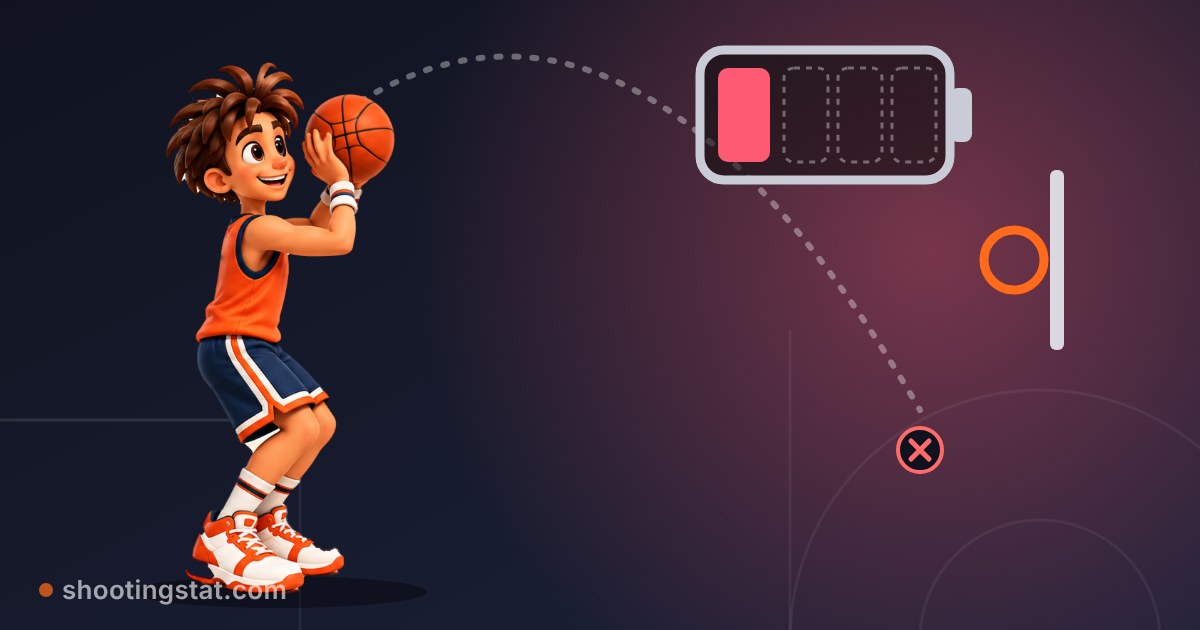
- Needs equipment: the ball's entry angle and depth.
What the app records, what you add, and what needs equipment.
01Layer one: what the app records
The zone. You tap where you took the shot on the court map, and ShootingStat assigns one of 15 zones: five near the basket, five mid-range and five threes. This is close to how NBA analysts classify shots: at the rim, mid-range, corner threes and other threes. FIBA's Statisticians' Manual (2024) also classifies a shot by type, such as a jump shot or a lay-up. The app doesn't record the type, but the zone tells you the distance and the angle.
Makes and misses. Log misses as carefully as makes. And log each shot right after it, because logging later makes it likelier that you forget some shots.
Free throws. They have their own tab, because they don't come from a zone and have their own percentage, FT%. They don't count in FG%, but they do count in TS%, as we explained in the difference between the three percentages.
02Layer two: context in the session title
The app doesn't know whether you were tired or whether a defender was in front of you, but you can write that in the session title, such as "Shooting after sprints" or "Shots against a defender." There are three reasons to do so:
Fatigue. A 2025 meta-analysis (Li and colleagues) found that moderate physical fatigue lowers two-point accuracy, and that severe fatigue lowers both two-point and three-point accuracy, with threes affected more. It also found that moderate mental fatigue lowers free-throw accuracy. So your percentage after a long school day or a hard workout is not a fair measure of your ability. To try this in practice, read shooting when tired.
The defender. In an analysis of more than 32,000 NBA threes (2014–15 season), published in The Sport Journal in 2024, the predicted chance of a make was about 39% when the defender was 9 feet (about 2.7 m) or more away, against about 29% when the defender was 3 feet (about 1 m) or closer. The app doesn't record defender distance for each shot, so we suggest separating sessions with a defender from sessions without one.
Games and practice. The researcher Toma analyzed more than 2 million free throws (2002–2013) and found that accuracy drops in the last 30 seconds of close games, by roughly 2 to 6 percentage points depending on the league. So don't compare your game percentage directly with your practice percentage. Compare each kind with its own kind.
Key point
The session title is the simplest way to turn your numbers into a fair comparison: "rested" against "after effort," "no defender" against "with a defender," and "practice" against "game."
03Layer three: what needs equipment
Some systems, such as Noah, ShotTracker and HomeCourt, measure the ball's entry angle and depth and count shots automatically. But the "ideal" numbers these companies promote come from their own data, and we found no published independent validation of these systems' accuracy. An independent 2019 review of HomeCourt found that it counted some loose bounces on outdoor courts as attempts. So regular manual logging is enough for most players, and it teaches you to watch every shot.
04When to judge your numbers
Don't judge from one week. An analysis of seven NBA seasons estimated that three-point percentage needs about 750 attempts before it is half skill. That is an estimate from an analytics blog, but the idea is clear: the fewer the attempts, the more luck matters.
Expect a return to the average. If your week was unusually good or bad, the next one is likely to be closer to normal even with no real change. Statistics calls this "regression to the mean."
Compare sessions of the same kind. We suggest looking at at least three similar sessions before you change anything in your training.
05Summary
Log each shot right after it: the zone, and make or miss.
Write the session's context in its title: fatigue, defender, practice or game.
Start with manual logging, and don't rely on devices' ideal numbers.
Compare similar sessions, and don't judge from one week.
In your next session, add its context to the title.
FAQ
Should I log my misses when I train alone?
Yes, with the same care as your makes. If you log only makes, your percentage rises on paper without your shot improving. We suggest logging each shot right after it, not at the end of the session.
How many shots should I log in a session?
There is no single right number. But keep the number of attempts fixed in the parts you want to compare, because with 10 attempts one shot moves the percentage by 10 points.
Is FG% enough to judge my shooting?
It is a good starting point, but it doesn't tell you where your shots come from. FIBA's coaching manual (Level 3) recommends measuring where shots are taken and who takes them, not just the score. That is why we log the zone with every shot.
Do I need a device to measure my arc?
Not for most players. Camera and sensor systems measure arc and depth, but their ideal numbers come from the companies themselves, and published independent validation is limited. Start with regular manual logging, which is enough to show you where you miss.