In a game, you don't shoot when rested. You shoot after running and contact, and in the final minutes you shoot tired. Yet most players practice their shot at their best, then wonder why their percentage drops in games.
In this article we suggest a 3-stage drill in which you compare your shooting when rested with your shooting after effort. The numbers and the order are our own suggestion, built on what studies say about the effect of fatigue.
Worked example
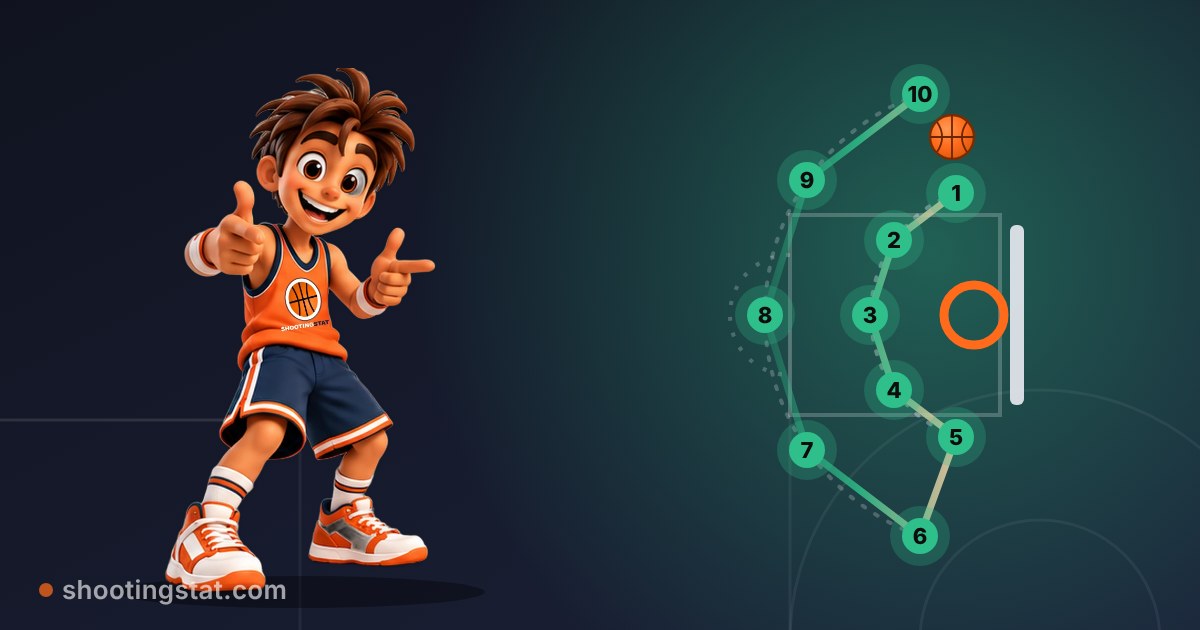
The drill in 3 stages:
- Rested: 10 shots from one spot, logged in one session.
- Effort: two rounds, each a sprint the length of the court and back followed right away by 5 shots, logged in another session.
- Compare: compare the two percentages and notice what changed in your shot.
The three stages in order, and what you log in each.
01What do studies say about fatigue?
A meta-analysis published in 2025 (Li and colleagues) found that moderate physical fatigue lowers two-point accuracy, and that severe fatigue lowers both two-point and three-point accuracy, with threes affected more. It found that moderate mental fatigue lowers free-throw accuracy. Adolescents were less affected by severe fatigue than adults.
In a small 2025 study of elite players, long-range shooting fell from 45.8% to 35.4% after repeated sprints, a statistically significant drop. Mid-range shooting fell from 62.5% to 56.3%, and that difference was not significant. The researchers linked this to the fact that a long shot depends on a longer chain of movement, from the legs to the trunk to the arm, which breaks down more when the player is tired. But the study is small, with only 48 shots per condition, so don't expect your percentage to fall by the same amount.
In another small randomized study (2026), four-minute shooting accuracy was 48.3% in the control condition. It fell to 39.8% after a physical workout, to 42.7% after a 30-minute mental task, and to 33.2% after both together. So if your percentage drops after a long school day and a hard workout, that is expected and doesn't mean your shot got worse.
These findings fit with what Toma observed in more than 2 million free throws: accuracy drops in the last 30 seconds of close games. But that is an observational analysis and doesn't prove that fatigue is the cause.
02Stage one: rested (10 shots)
Warm up first, then pick one spot to shoot from, ideally a zone where you shoot with confidence. Take 10 shots with your usual routine, as we explained in the free-throw routine. Log them in ShootingStat in a session titled something like "Shooting rested."
Once you have the drill down, you can repeat it from a three-point zone, because the small study found long-range shooting to be the most affected.
03Stage two: effort (10 shots)
Do two rounds back to back:
Sprint the length of the court and back at full speed.
Go straight to the same spot and take 5 shots.
Rest no more than half a minute between the rounds.
Log these 10 shots in a separate session titled something like "Shooting after sprints," so its percentage doesn't mix with the rested one. We suggest doing this stage after the first one on the same day.
Common mistake
Don't push the effort to exhaustion, especially with young players. The aim is moderate fatigue, like the last minutes of a game. If a player feels dizzy or feels pain, they should stop immediately, and the drill should only be done under the supervision of a coach or parent.
04Stage three: compare
Open both sessions and compare their percentages. Then ask yourself: what changed in your shot when you got tired? The problem may start in the legs. FIBA's Level 1 coaching manual lists power from the legs as one of the core keys of the shot, and when the legs tire, a player tends to make up for it with arm strength. That is our own inference, not a study's finding. So try these cues:
Start the shot from your knees, and don't push the ball with your arm alone.
Keep the same routine you use when rested.
Watch whether your shots fall short, which may point to weak leg drive.
And remember that one shot moves your percentage by 10 points in 10 attempts. So repeat the drill on 3 or 4 different days and look at the overall direction.
05For coaches
The drill suits a group of players at the end of practice. Put them in pairs: one sprints and shoots, the other rebounds and passes, then they swap. You can add it to a team shooting session as a final part. Log the group's results in a session titled "After effort," to compare it with a rested session.
06How to log it
Log both sessions with a fixed number of attempts, 10 shots each. Write the context in the session title, as we explained in what to log for every shot. And compare sessions of the same kind, not a rested session and an effort session from completely different days.
07Summary
Fatigue lowers shooting accuracy, and threes are affected more than other shots.
Shoot 10 shots rested, then 10 after two sprints, and compare.
Keep the effort moderate, and don't exceed it with young players.
Keep your routine, and start the shot from your legs.
This week, pick one spot and run the three stages.
FAQ
Is this drill suitable for young players?
Yes, as long as the effort is moderate, not to the point of exhaustion, and under the supervision of a coach or parent. The 2025 meta-analysis found that adolescents were less affected by severe fatigue than adults, but that doesn't mean they are unaffected. If a player feels dizzy or feels pain, they should stop immediately.
How often should I do the drill?
We suggest once a week, at the end of practice. The aim is to measure the effect of fatigue and get used to it, not to practice your shot while exhausted all the time.
Should I expect my percentage to drop by 10 points?
No. That figure came from a small study of elite players, with only 48 shots per condition. Your drop may be bigger or smaller. What matters is comparing your percentage with your own across several days.
Why compare after only 10 shots? Isn't that too few?
It is few, because one shot moves the percentage by 10 points. That is why we suggest repeating the drill on 3 or 4 different days and looking at the overall direction, not a single day.