You shot 52% last week and 38% today. Your first thought may be that something is wrong with your shot. Sometimes it is. More often, one of three simpler things is going on: too few shots, tiredness, or ordinary ups and downs.
This article gives you four questions, in order, to ask before you change anything.
The four questions
1. Do you have enough attempts?
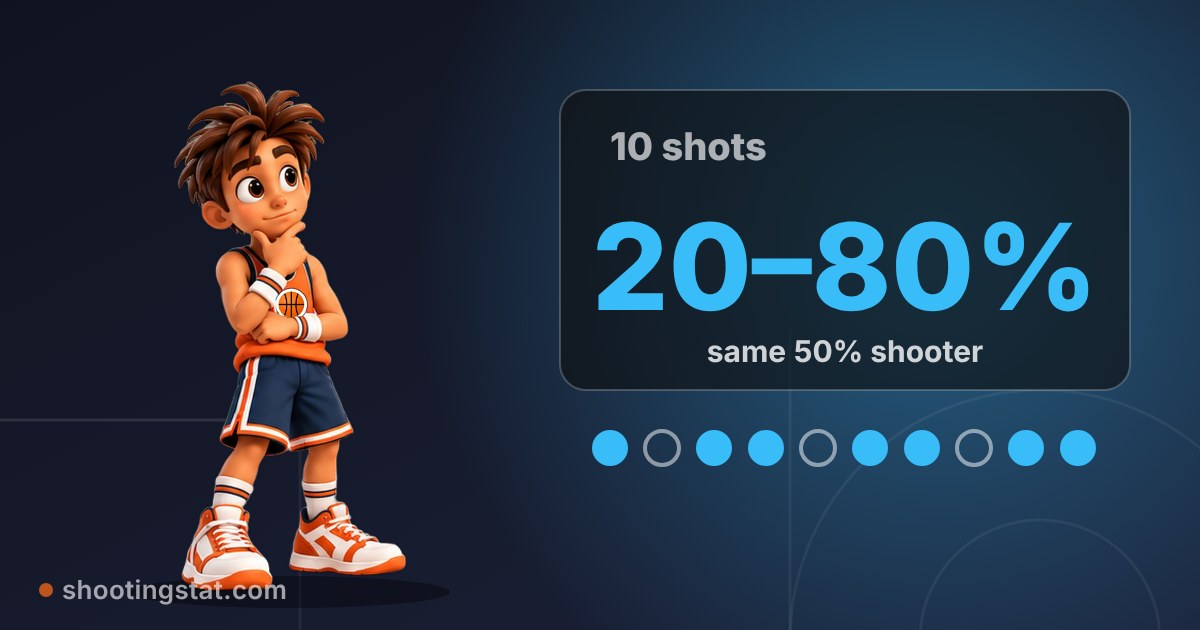
ShootingStat shows a "small sample" hint when a zone has fewer than 10 attempts, or a session has fewer than 20. If you see it, stop here. Over 10 shots, a player whose true level is 50% can easily land anywhere from about 20% to 80%, as we showed in small samples. A drop from 7 of 10 to 4 of 10 is well within that range.
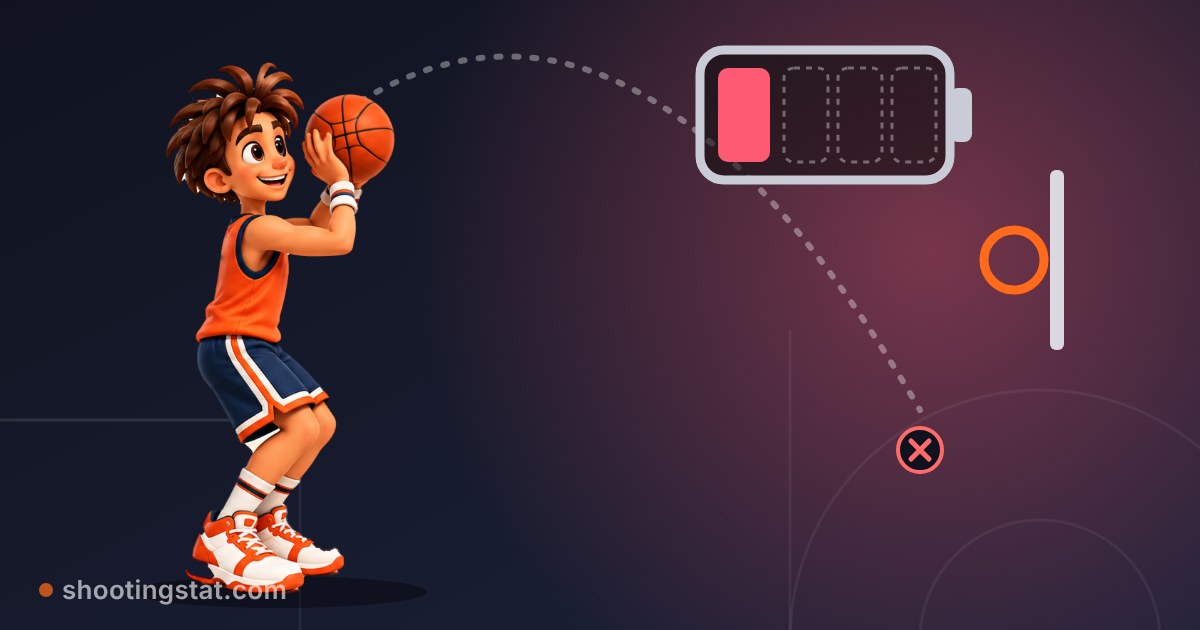
2. Were you tired?
Studies point the same way: tiredness lowers accuracy.
- A 2025 meta-analysis found that moderate physical fatigue lowers two-point accuracy, and severe fatigue lowers both two-point and three-point accuracy, with threes hit hardest. Moderate mental fatigue lowered free-throw accuracy. Adolescents were less affected by severe fatigue than adults.
- In a small study of elite players, long-range shooting fell from 45.8% to 35.4% after repeated sprints. Mid-range shooting fell from 62.5% to 56.3%, a change that was not statistically significant.
- In a small randomized study from 2026, four-minute shooting accuracy was 48.3% in the control condition, 39.8% after a physical workout, 42.7% after a 30-minute mental task, and 33.2% after both.
These are small studies, so do not expect to drop by the same amount. But they explain why a long school day followed by a hard workout can lower your percentage without your shot getting worse. If you were tired, the drop is expected, and the fair comparison is another tired session, not your best rested one. Our tired shooting drill shows how to measure it.
3. Does the drop repeat?
If you had enough attempts and you were not tired, wait. After an unusually high or low result, the next result tends to move back toward your average even if nothing changed. This is called regression to the mean, and it is why a hot week is often followed by a cooler one.
So compare at least three similar sessions: the same spots, the same number of shots, the same kind of day. A drop that appears in one session is noise. A drop that appears in all three is a signal.
4. Look at your form
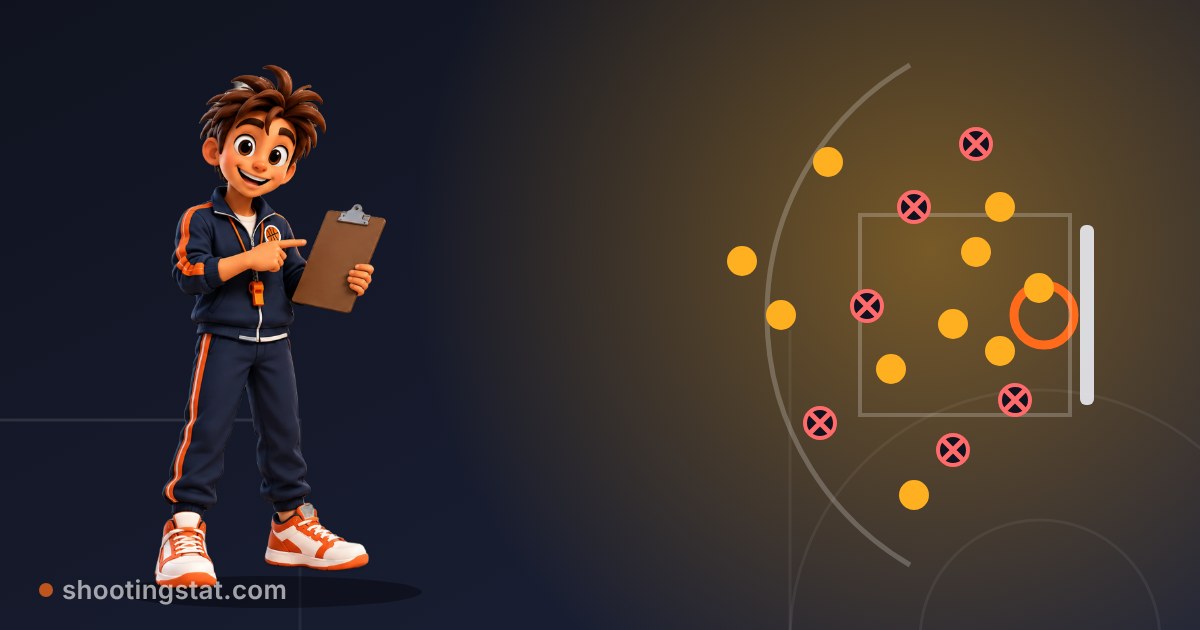
When the drop survives the first three questions, it deserves attention. Look at where you miss: short, long, or to one side. Common shooting mistakes explains what each pattern may mean. Fix one thing at a time, and ask your coach to watch you shoot, because someone else often sees what you cannot feel.
Common mistake
If anything hurts, stop shooting and have it checked. A drop in your numbers that comes with pain is not a statistics question.
How to make this easier next time
The app does not know whether you were tired, so tell it. Write the context in the session title: "Rested", "After sprints", "After school", "Game". We explained this in what to log for every shot. Then, when your percentage drops, question two answers itself.
Quick reference
| What you see | Most likely | What to do |
|---|---|---|
| Drop in a zone with under 10 attempts | Small sample | Collect more shots from that zone |
| Drop after a long day or hard effort | Fatigue | Compare with another tired session |
| Drop after an unusually good week | Ordinary ups and downs | Wait for three similar sessions |
| Same drop in three similar sessions, in several zones | A real signal | Check your misses and ask your coach to watch |
| Drop with pain | Not a statistics question | Stop and have it checked |
Summary
- A drop in your percentage often comes from too few shots, tiredness or normal ups and downs.
- Ask four questions in order: attempts, tiredness, repeats, and only then your form.
- Name your sessions so you can compare tired with tired and rested with rested.
- If anything hurts, stop.
After your next session, write one word in the title that describes how you felt.