A free throw is the one shot in basketball nobody can block. No defender in your face, the game clock stopped, the same distance every time. And yet it is the shot that gets harder when the game is close and the seconds run out.
This article is about the numbers: what the research found, and how you can measure the gap between your free throws in practice and your free throws under pressure.
What the research found
NBA, eight seasons. In a study of play-by-play data from 2002–03 to 2009–10, economists Cao, Price and Stone found that free-throw accuracy was about 5 to 10 percentage points lower in the final seconds of very close games. A team trailing by one point in the last 15 seconds shot about 8.8 points worse, and a team trailing by two shot about 6.3 points worse. There was no drop when the game was tied. The effect was larger for weaker shooters, and for a second shot after a miss.
More than 2 million free throws. Toma analyzed the NBA, the WNBA and college basketball between 2002 and 2013. In the final 30 seconds of tight games, accuracy fell by about 5.81 points in the WNBA, 3.11 in the NBA and 2.09 in men's college basketball. In women's college basketball the drop was 2.25 points, and it was not statistically significant.
These are observational studies of averages. They suggest that pressure is real at every level, but they cannot prove its cause, and they cannot tell you what will happen to you.
Why one missed free throw matters
A free throw is worth one point, so its points per attempt equals your percentage. Ten free throws at 70% give 7 points, and ten at 60% give 6. One point sounds small, but close games are often decided by a single point. Free throws also count in TS%, which we explained in FG% vs eFG% vs TS%.
How to measure your own gap
You do not need a crowd. You need two kinds of sessions with a clear label.
- Practice session. 10 free throws, your normal routine, no consequence. Title: "Free throws, practice".
- Pressure session. 10 free throws with something at stake, such as a team that has to run if you miss, a score to beat, or teammates watching. Title: "Free throws, pressure". Our free-throw drills include a game-like pressure part you can use for this.
- Repeat on three days. That gives you 30 attempts in each type.
- Compare the totals. Add makes and attempts for each type, then calculate the percentage.
How to read the gap
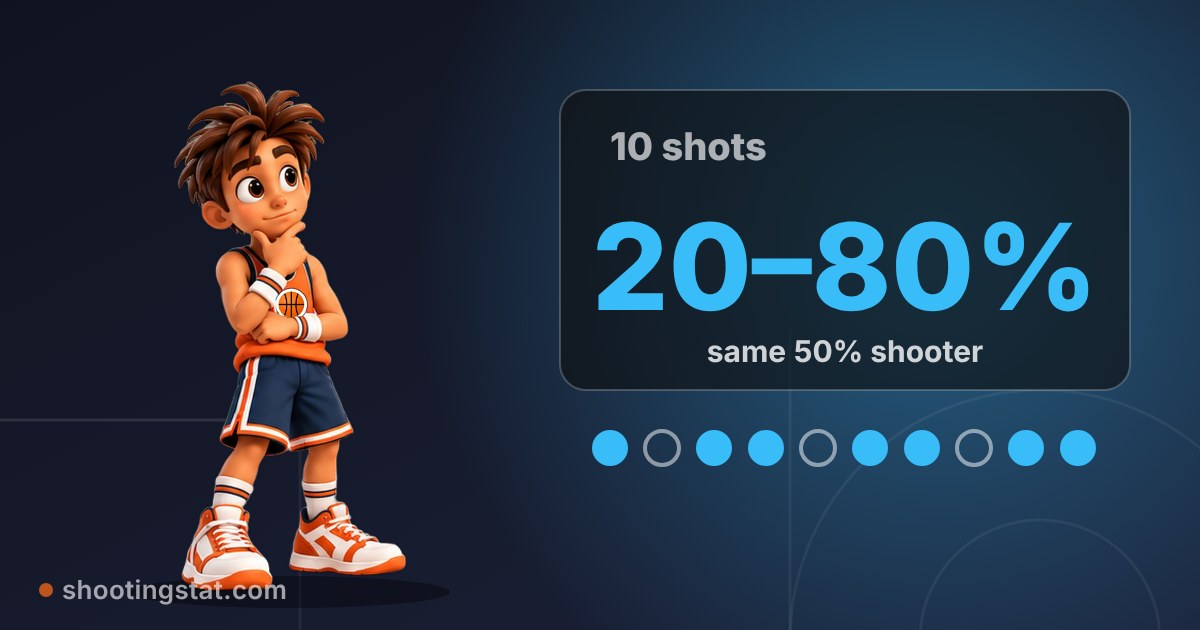
The number you get is the difference between your practice percentage and your pressure percentage. Before you read anything into it, remember the sample size. With 10 free throws, a 70% shooter's result can land anywhere from about 50% to 100%, so one session cannot show a real gap. With 30 attempts per type, the picture is much steadier, and our small samples article explains why.
- A gap of a few points is normal, and it matches what the research found for professionals.
- A gap above about 10 points across three sessions deserves attention. Look at what changes in your routine when the pressure rises: do you rush, skip a step, or look away from the rim? See the free-throw routine.
- No gap at all is good news, but check that your pressure session really felt different.
Common mistake
- Don't judge from one session. Ten free throws are too few to show a gap.
- Don't mix the two types. Keep practice and pressure in separate sessions, or the numbers blur together.
- Don't expect your usual percentage. Tiredness and pressure together lower accuracy, as we saw in the tired shooting drill.
Summary
- Studies of real games found that free-throw accuracy falls in the final seconds of close games, by about 2 to 10 points depending on the league and the situation.
- Log practice and pressure free throws in separate sessions.
- Compare totals over at least three sessions, about 30 attempts for each type.
- A small gap is normal. A gap that stays above about 10 points is worth working on.
This week, add one pressure session to your free-throw practice and label it clearly.